Tenofovir disoproxil
Viread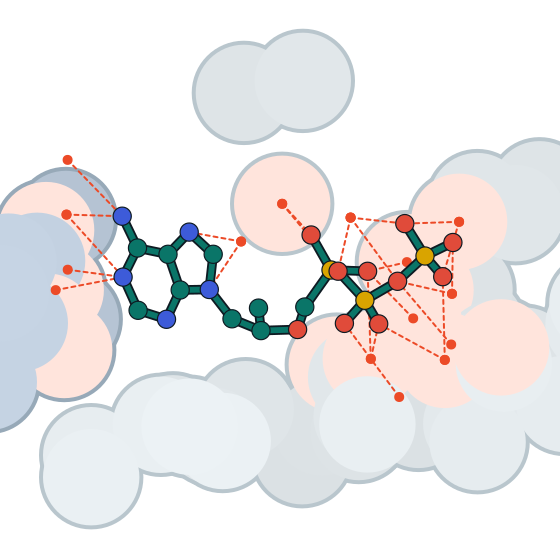
24 polar contacts with 8 residues and 2 DNA nucleotides, each within 3.5 Å
Shown: tenofovir diphosphate, the active form the body makes from tenofovir disoproxil.
The DNA in the structure is drawn in a darker blue-grey: the drug sits against it as well as against the protein.
Interferes with a key enzyme HIV and hepatitis B viruses need to copy their genetic material, slowing the virus's ability to multiply.
How it works
Once swallowed, the drug is converted by the body into its active form inside cells. That active form looks enough like one of the natural building blocks of DNA that the virus's copying machinery mistakenly uses it instead. But this fake building block is missing a piece needed to keep the DNA chain growing, so the copying process stops there. This blocks both HIV and hepatitis B virus from making new copies of their genetic material.
What it’s used for
Used, together with other HIV medicines, to treat HIV-1 infection in adults and children as young as 2. Also used on its own to treat long-term hepatitis B infection in adults and children in that same age range.
- Mechanism
- Reverse transcriptase inhibitor (nucleotide analog)
- Drug class
- Small molecule
- Therapeutic area
- Antiviral
- Structure shown
- X-ray, 2004