Remdesivir
Veklury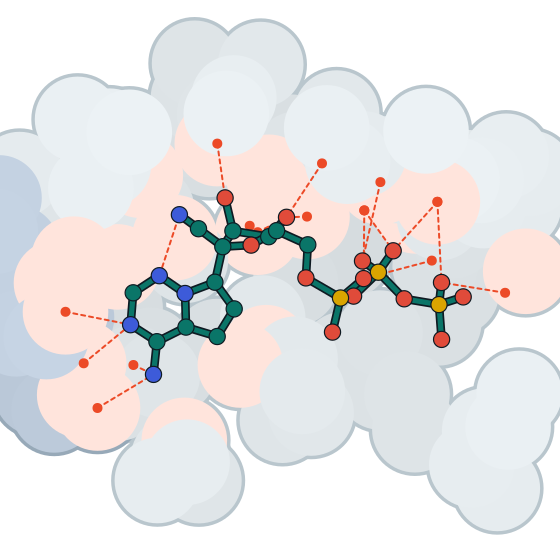
17 polar contacts with 7 residues and 3 RNA nucleotides, each within 3.5 Å
Shown: remdesivir triphosphate, the active form the body makes from remdesivir.
The RNA in the structure is drawn in a darker blue-grey: the drug sits against it as well as against the protein.
Stops the coronavirus from copying its genetic material, halting the infection from spreading further in the body.
How it works
The virus that causes COVID-19 needs to copy its genetic code to multiply inside the body. Remdesivir is converted inside cells into a building block that looks like one the virus normally uses to build new copies of its RNA. When the virus's copying machinery grabs this look-alike piece instead of the real one, the copying process gets jammed and stops partway through, blocking the virus from reproducing.
What it’s used for
Used to treat COVID-19 in people who are sick enough to be hospitalized, as well as in people with mild-to-moderate COVID-19 who are at high risk of getting seriously ill. It's given as an IV infusion, approved for both adults and children.
- Mechanism
- RNA-dependent RNA polymerase inhibitor (nucleotide analog)
- Drug class
- Small molecule
- Therapeutic area
- Antiviral
- Structure shown
- Cryo-EM, 2022