Panitumumab
Vectibix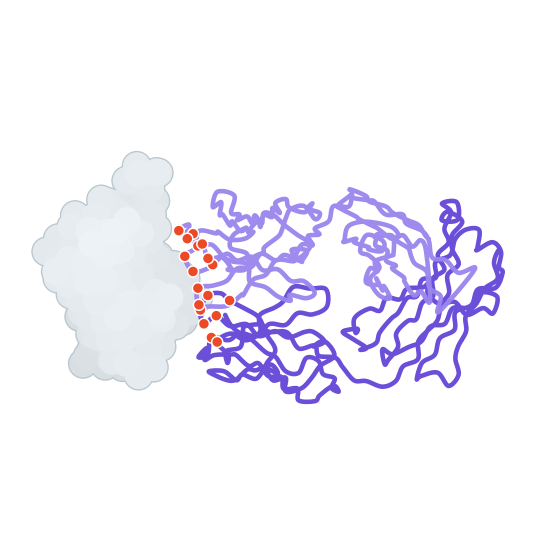
18 antibody residues touch EGFR, each within 4 Å
Shown: the antibody's Fab, its antigen-binding arm, not the whole antibody.
A lab-made antibody that latches onto the EGFR growth receptor on cancer cells, physically blocking the growth signals that would otherwise tell the tumor to keep dividing.
How it works
Cancer cells often carry a receptor called EGFR on their surface that acts like a grow button. Panitumumab is an antibody engineered to sit on that same docking site first, so the natural growth signal can't get in and the button stays off. This only works if the cell's internal wiring downstream of EGFR is still listening to that receptor, which is why the drug isn't used in tumors with a RAS gene mutation.
What it’s used for
Used to treat colorectal cancer that has spread, but only in patients whose tumor has been gene-tested and found to have a normal RAS gene. Doctors won't prescribe it without first checking the tumor's RAS gene status.
- Mechanism
- EGFR antagonist (mAb)
- Drug class
- Monoclonal antibody
- Therapeutic area
- Oncology
- Structure shown
- X-ray, 2016