Latanoprost
Xalatan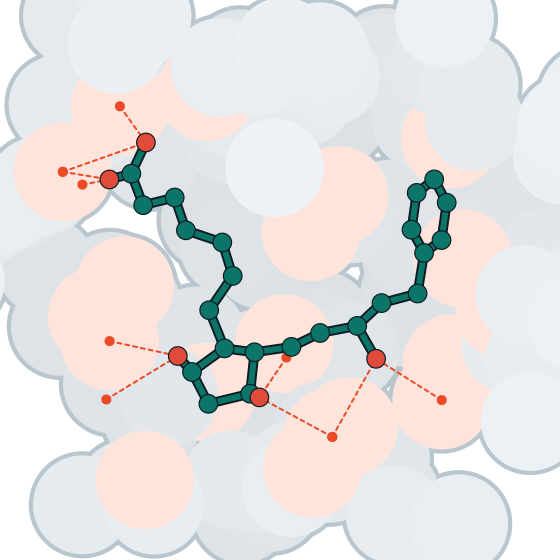
10 polar contacts with 7 residues, each within 3.5 Å
Shown: latanoprost acid, the active form the body makes from latanoprost.
Increases natural drainage of fluid from the eye to lower pressure inside it.
How it works
Latanoprost starts out as an inactive eye drop that your cornea converts into its active form once applied. That active form attaches to specific receptors in the eye and opens up an alternate drainage channel, letting the fluid inside the eye flow out more easily. This lowers the pressure inside the eye, with effects starting in a few hours, peaking by half a day, and lasting a full 24 hours — which is why it only needs to be used once a day. Rather than reducing how much fluid the eye makes, it works by helping the eye get rid of fluid faster.
What it’s used for
Used to lower high pressure inside the eye in people with open-angle glaucoma or ocular hypertension, helping protect vision from damage caused by that pressure.
- Mechanism
- Prostaglandin F2-alpha analog
- Drug class
- Small molecule
- Therapeutic area
- Ophthalmology
- Structure shown
- Cryo-EM, 2023