Rivaroxaban
Xarelto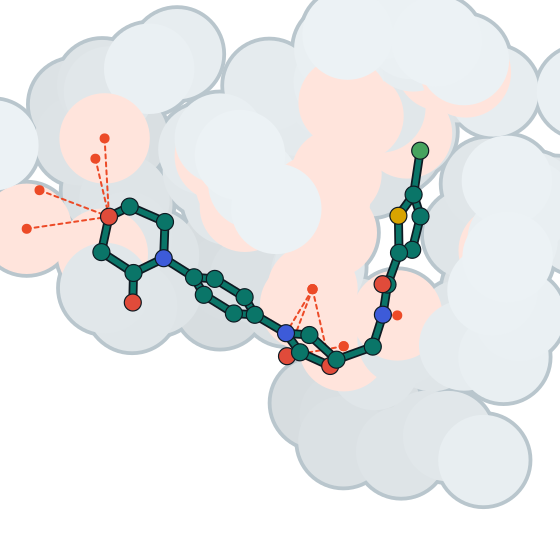
10 polar contacts with 5 residues, each within 3.5 Å
Blocks a clotting factor called Factor Xa, a key step in the chain reaction that forms blood clots, so blood clots less readily and existing clots are less likely to grow.
How it works
Rivaroxaban works by blocking Factor Xa, one of the key proteins in the chain reaction your blood uses to form clots. With Factor Xa blocked, your blood generates much less of the substance (thrombin) that triggers clotting, so it clots less readily and existing clots are less likely to grow.
What it’s used for
Rivaroxaban is a blood thinner used for a wide range of clotting problems: preventing stroke in people with an irregular heartbeat called atrial fibrillation, treating and preventing recurrence of blood clots in the legs (DVT) or lungs (PE), preventing clots after hip or knee replacement surgery or in certain at-risk hospitalized patients, and — combined with low-dose aspirin — lowering the risk of heart attack, stroke, or serious limb complications in people with coronary or peripheral artery disease. It carries two boxed warnings — the FDA's strongest safety warning: stopping it early, for reasons other than a bleeding problem or finishing a planned course of treatment, raises the risk of a stroke or dangerous blood clot; and receiving spinal anesthesia or a spinal tap while on rivaroxaban carries a risk of a blood clot forming around the spinal cord that can cause lasting or permanent paralysis.
- Mechanism
- Factor Xa inhibitor, blocks clotting cascade to reduce thrombin generation
- Drug class
- Small molecule
- Therapeutic area
- Anticoagulant
- Structure shown
- X-ray, 2008